
How “Voodoo” Caused Most of the National Debt
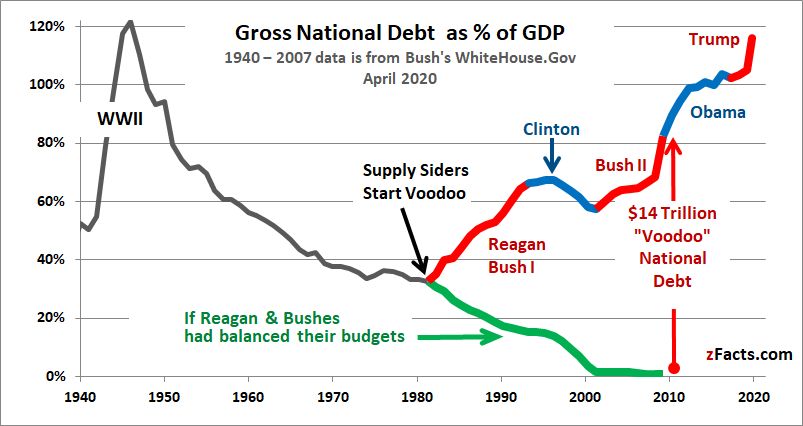
Here’s how national-debt policy was captured by Wall Street and went crazy. You can see exactly when it happened in this graph. You can even see George H.W. Bush predict it in the video clip below when he was running against Reagan — and then take it back when he became Reagan’s choice for VP.
World War II was looming, and the country was flat broke. But Uncle Sam was popular, the country patriotic, and all were happy to lend him money. Compared to the size of the economy back then, the debt soon outstripped even today’s debt, and we won the war. Then, without any to-do, we almost paid it off, until …
Something weird happened. When Ronald Reagan became president. He rode to office on complaints of an “out-of-control debt” that was as big as “a stack of $1000 bills 67 miles high.” And in eight years in office he added another 125 miles to that stack!
As the graph shows, the national debt was actually at its lowest point in 50 years compared to the US economy, but Reagan grew the debt much faster than he grew the economy. That’s why the graph shoots up when he takes office. No one had done that since Word War II, and Reagan had promised to balance the budget. That’s weird.
Debt: Total owed from past and present borrowing.
Deficit: This year’s borrowing.
Emergency for Democrats: When Biden drops out, If there’s no safe Plan B, the party will fall into disarray and lose for sure. So far the only proposed Plan B is for Biden to endorse Harris at the convention. That’s not a safe plan. She’s not popular and the convention will be open and can revolt. Read about alternatives and have your say here: Biden Plan B, or, at BidenPlanB.org.
Get a Free, Customizable National Debt Clock here.
But one guy saw it coming and said so loud and clear. And years later, this first-class Republicn would say he was voting for Hillary Clinton (09/19/16). His name is George H. W. Bush, the 41st president of the United States.
He called Reagan’s plan Voodoo economics, and when it came to the debt, that Voodoo made a zombie out of Reagan and generations of Republicans. Unfortunately Bush lost the primary to Reagan, and Reagan made him vice president. So not long after he called Voodoo on Reagan, he had to deny he ever said it. It’s well worth 22 seconds of your time to watch this:
What is Voodoo Economics? (here’s more of the backstory)
Invented at a restaurant just off Wall Street by Wall Street journalists (and a kooky economist), its official name is “supply-side” economics. Don’t be fooled, in 40 years this has not become part of real economics. That’s because its central tenet is this:
“You cut taxes, and the tax revenues increase.” —Voodoo Economics
You gotta admit that sounds pretty weird. You also have to admit that if Reagan believed that, he surely would have cut taxes. And he did. If it turned out to be crazy (which it was) then tax revenues would actually have fallen, which they did. So Reagan proved Bush was right. Supply-side tax policy is voodoo.
With revenues down, the government was short of money and had to borrow like crazy, and the national debt went up.
Check out: Biden vs Trump — latest polls
But come on. Nobody really believes such nonsense, least of all our presidents. Well, maybe you should watch this eight-second video from 2006.
Yes, that’s George Bush II. By 2006 he should have known better. One month after taking office in 2001 with a plan to cut taxes, he said he would “retire nearly $1 trillion in debt over the next four years. … the largest debt reduction ever achieved by any nation at any time.” Instead, the national debt went up by $2 trillion. But he remained under the spell of voodoo economics.
The same thing happened to him as to Ronald Reagan. He cut taxes, believed tax revenues would increase, but surprise — tax revenues went down. So the government had to borrow more. And the Debt, which had been going down, suddenly shot up. Once again it grew even faster than the economy and that’s why you see the graph going up in his first budget year.
Fool me once, shame on you. Fool me twice shame on me. Should we go for three times? You would think that after 20 years of Voodoo experiments turning out just like any sane person would expect, that at least the best and brightest Republicans would catch on. So here we are in 2015. Trust me again for 14 seconds and listen to Fiorina and Rubio:
As Carly says, this may seem crazy to you. But here are two of the brightest contenders in the 2016 Republican primaries repeating the same old Voodoo. When it comes to the debt, the GOP is the party of zombies.
The national debt in perspective
Consider what it means when the graph says 100%. It means the national debt equals one year of Gross Domestic (National) Product (GDP). So if we used the full value of what the US produces for one year just to pay off that debt, that would just do it. And 50% means the debt would be paid off in six months of using the full output.
That sounds outlandishly huge, but consider a family making $100,000 a year that buys a $250,000 house with 20% down and takes a $200,000 mortgage. No one considers this unusual or risky. But that family would be off the top of the graph at 200%. It would take all they made for two years to pay off their debt. And the US has a slight advantage over most families. It can print money. So there is zero chance of default.
And only about 1/4 of the national debt is owed to foreigners. Another 40% is owed to Americans, for example, pension plans own quite a bit of it. And the rest is owed by the US government’s “General Fund” to other Government Trust Funds, like the Social Security Trust Fund and the military’s pension fund.
Stop with the doom and gloom. If, as conservatives fear, the Chinese tried to bankrupt us by cashing in all their treasury bonds, we could simply print the money and pay them. Not a problem. And no, the high debt is not harming our credit. If you have bad credit, people will only loan you money at a high interest rate. Everyone in the world is willing to loan Uncle Sam money at almost zero interest. He’s got absolutely the best credit rating in the world.
Click for an explanation of the Green Line, balanced budgets, tax cuts and a bit of Keynesian stimulation.
[It’s time we saw through wokeism: True Woke Secrets Their bias is hidden in what they don’t say and what they don’t allow to be said. These are, in effect, woke “secrets.”]
 Ripped Apart


Well written Post..
Also, just in case anyone wants to know..
“WHAT EXACTLY IS THE UNITED NATIONS AGENDA 2030 WHICH IS CURRENTLY BEING ENFORCED GLOBALLY?”, pls visit my blog 👇https://bibleprophecyinaction.blogspot.com/
Didn’t the national debtgi up during the Reagan years because tip oneal would stop spending?
You do recall that a Presidential veto is a cure for any bill passed by Congress, right?
Blaming Dems is a favorite tactic of Reps. Meanwhike, Reagan’s supply-side economics combined with unprecedented defense spending created out of control debt. At tge same time lower budget social programs suffered. Sound familiar?
Since, in the here and now, the US credit rating just took another hit, and our interest rates are going up, I’d say that at the very least the conclusions of this article is DEBUNKED.
Own up!
Do you even know what you’re looking at? Every President reduced Debt since WWII until Reagan killed all progress and Bush Sr.continued it until Bill Clinton did what all the other Presidents did and reduced the debt created a booming economy that worked for all until he handed it to G W Bush who by the time he was done in 2008 Economists were saying the economy could be beyond repair. If Reagan and the Bushes balanced their budgets like all before them the country would have been debt free when Obama-Biden took office
Not at all true. Every president since Hoover added to the debt. Only reason it wasn’t a problem was as stated the economy was growing faster than our debt. No president since Coolidge had a balanced budget his whole term.
How about just posting total? To measure against GDP during Covid shut down is misleading …
The GNoP handled Covid very poorly, so it is not misleading.
Trump added 2 Trillion starting with the usual Tax Cut handouts to the Rich that have destroyed every Republican Economy& now Trump wants to go bigger with & 7 Trillion in Tax Cuts for himself & the Rich. When will the public finally learnof this failing cycle and show that Republicans catering to the Rich has destroyed every Economy they’ve touched only to hand Democrats recessions & the worst financial disaster since the Great Depression caused by GW Bush & Democrats every time build record breaking economies from Clinton who holds #1 for strongest stock market ever, Obama/Biden dug out of what was said to be beyond repair and built a record breaking economy and jobs yr over yr & they hold #2 strongest market ever and handed their booming Economy to Trump who still takes credit for something he didn’t build but destroyed adding 8 Trillion to the debt.Again Biden HarrisDemocrats had to rebuild the economy & economists say its the best everbuilt
Hahaha. The economy was strongest under Trump them any day under Obama and Biden. The next republican president will have to fix Biden’s mess just like Trump fixed Obama’s mess. Under republican presidents prices and down, spending down and inflation down then democrats. Obama has the highest amount of debt added for any president. Biden has the highest inflation of any president. Those are failures. And nearly 60% say they were better off 4 years ago. That’s not a sign of a strong economy.
How’s that shitty take coming along. It was wrong then and it’s absolutely hilarious now.
Trump has already taken care of his wealthy with all his blustering hullabaloo about tariffs. The market dropped. The ultra-wealthy (mostly Republicans and more so his supporters) swooped in and adhered to the old axiom, sell high, buy low. Once they had they had chomped up all they could get while the market bottomed out, voila, Trump started “pausing” the higher tariffs, and like “magic” the market began to climb again. Coincidence? Hardly. That was the plan all along.
Lies, What about the twin towers when we were attacked on our land that’s not in that little part and you say Reagan and Bush if they manage their budget what about Clinton sending all kinds of our jobs overseas.
Completely asinine. Reagan’s and Trump’s policies both INCREASED federal tax revenue. Congressional spending caused our Debt and Quantitative Easing destroyed our economy.
Reagan, Bush Sr, G.W.BUSH and Trump did what no Presidents have done and they all got the same result. First thing was huge Tax Cuts for wealthiest in US. Claimed more money the wealthy had allows some to Trickle down to everyone else. Trickle Down Economics only benefits the rich & put the US on a path of destruction. Republicans haven’t handed a successful Economy to Dems in a 1/2century while every Econ Dems handed to Repub was Booming.Dems rebuild Booming Economies from Repub.ashes especially after G.W.BUSH. Dems repaired Rep damage & broke records at every level debt was leveling off when it was handed to Trump who instead of reducing debt after all the work that had been done he added 8Trillion in 1 term w 2T Tax cuts & w the same deregulation behind housing crisis 2008 that emptied all retirement accounts
False. Bush 1 economy was booming and Clinton simply followed it and gave it to Bush before Clinton’s policies cause the Great Recession. Obama handed a failed economy to Trump who made it boom again then to let Biden destroy it. The whole democrat have good economies is simply they feed off the work from republicans who had to fix there failures.
You’re completely out of your mind. None of what you said makes any sense or has any basis in reality or is supported by any numbers anywhere. How are you arguing they ride coattails when Biden had to ride Trump’s dogshit economy and handling of covid and now we’re in the shit dimension a second time. He’s obviously retarded.
Republicans are not conservatives. The first thing they do is cuts and give away the governments ability to balance the budget. Started with Reagan. Sad, I voted Republican until George Bush II 2nd term. The government needs to help people. Republicans just want to stay at the in power.
HI Gary, True. Republicans are not conservative, any more than Fascists are Conservative. Conservative has nothing to do with ecology or economy or – it has to do with the status quo, old money, old power, old institutions. And, the worst thing Ronald Reagan did, was to order the FCC to stop enforcing “The Fairness Doctrine” that gave Limbaugh free reign to lie all day long, with no rebut right there, on the spot, same time same station. Every time. So wouldn’t it be easier to lie all day long if there was no fairness doctrine ? So they put their standard lies on steroids. The biggest lie, which Rush Limbaugh, etal., made go viral, is the debate frame itself. GOP want and do frame the debate as “Capitalism vs. Socialism”, when, in reality, we all do capitalism and socialism every day, and “Capitalism vs. Labor” is still the same old standard and solid frame with itself, but the KIND of capitalism/labor (and associated markets for both) depend on how Congress votes to regulate both capitalism and labor. #Fascism: Corporations in bed w/govt making rules for the people to live with. #Socialism: The people in bed w/govt making rules for the corporations to live with. Please note that the U.S. Constitution predates both #words. And, “We The Corporations” is not in the U.S. Constitution anywhere. So, look and you tell me, – which party agenda has gone over the edge. If the people are in bed w/govt, then we get ingredient labels on food, after fighting the GOP tooth and nail as they scream the auto companies can’t afford this, so they will mark up the price of cars and then people can’t afford cars.. Total corp side, v, the people and our safety /health. So, socialism peeks its head… Read more »